
INTERPRETING
As an interpreter with 23+ years of experience and the following credentials
- Contract Simultaneous Interpreter with the U.S. Department of State
- Certified Court Interpreter accredited in Michigan and Ohio
- Professionally Qualified Russian Interpreter for U.S. Courts (National Court Interpreter Database)
- Recipient of the University of Massachusetts Certificate in Healthcare Interpreting
I am looking forward to serving you and your organization. My goal is to facilitate understanding and communication across language and cultural barriers while remaining unobtrusive and invisible.
I provide the following services:
- Simultaneous interpreting (speakers do not pause for interpretation)
- Consecutive interpreting (speakers pause for interpretation)
- Voice-over (Russian) and voice-over supervision
in these settings (on-site and remotely):
- Conferences
- Lectures and presentations
- Meetings and seminars
- Courts
- Manufacturing sites
and in many other venues, as well as remotely via audio-visual equipment
Here is some basic information you'll need in order to be an educated consumer of language services:
What Is a Difference between Interpreting and Translation?
Although most language work is lumped into the category of ‘translation’, there are some definite differences between translation and interpreting. Translators work with the written word, converting texts from one language into another, while interpreters render spoken words. Both translators and interpreters must have an excellent command of their working languages, are obligated to relay source messages with utmost accuracy and completeness, as well as to maintain impartiality and neutrality. However, their work conditions and skill sets differ significantly. Interpreters need to understand the incoming speech and render it in another language instantaneously. There is no time to consult dictionaries or research unfamiliar terms. Interpreters work in the three main modes -- simultaneous, consecutive, and sight translation -- and in various settings: meetings and conferences, courts, businesses, educational and medical facilities, to name a few. Professional interpreters are familiar with codes of conduct, ethical principles, and protocols appropriate for each field.
Who Are Credential Interpreters?
Credentialed interpreters in the United States are tested and trained by various accrediting entities. Less than 20% of applicants pass interpreter certification and qualification examinations. As a credential interpreter with many years of experience, I will be delighted to help you and your organization to determine the type and the scope of interpreting services that are best suited to your needs.
How Do Interpreters Work?
Interpreters work in the three main modes: simultaneous, consecutive, and sight translation.
Simultaneous Interpreting
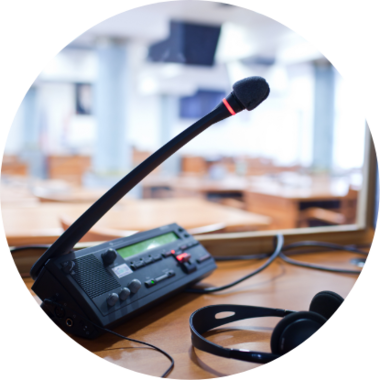
The interpreter renders the interpretation into the target language continuously, at the same time as the speaker delivers his speech in the source language, just a few “units of meaning” behind the speaker. The time lag between the moment when the speaker utters an idea and the interpreter interprets the same unit of information is called decalage. Simultaneous interpreting is delivered by using special equipment that allows the recipient of the interpreted message to listen only to the interpreter and tune out the source speech.
Consecutive Interpreting
The interpreter orally translates a statement made by the speaker after the speaker stops talking. The process follows a sequence: first interlocutor > interpreter > second interlocutor > interpreter > first interlocutor > interpreter, etc. Only one person should be speaking at a time.
Sight Translation
Sight translation is a cross-over between translation and interpreting. The interpreter reads (not out loud) a written document in one language and instantaneously translates it orally into another language.
FIELDS OF EXPERTISE